
 |
|
|
|
|
|
|
|
|
|
|
|
|
|
|
|
|
|
|
|
 |
|
||||||||||||||||||
 |
 |
 |
|
||||||||||||||||
 |
|
||||||||||||||||||
 |
 |
 |
 |
 |
 |
 |
 |
 |
 |
 |
 |
 |
 |
 |
|
||||
 |
 |
 |
|
||||||||||||||||
 |
 |
 |
 |
 |
|
||||||||||||||
 |
 |
 |
|
||||||||||||||||
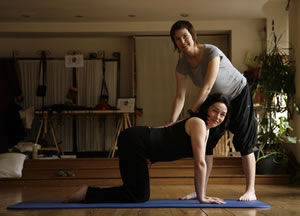
Lie down, you'll soon feel better What is Feldenkrais? Well, it's a postural technique to promote 'functional integration'. Forget that -- all you have to know is that it's magic, says Anna Burnside I am lying on my back contemplating my vertebrae. More specifically, I am trying to locate, map and measure the depth of indentation my backbone is making in the yoga mat below. |
 |
I have already considered my skull: which bits are in contact with the floor and what shape they might leave behind. Once a week I lie on this mat, in this yoga studio and put my body through a challenging Pilates workout. So when Vanessa Smith, a former dancer and my teacher, mentioned the Feldenkrais technique, I assumed it was more of the same, perhaps with even tougher sit-ups. She was enthusiastic, if evasive, when questioned about what the method actually was. The most I could get out of her was that she absolutely loved it. Which is why I am spending the afternoon learning the rudiments of what Moshe Feldenkrais, who gave the discipline his name, called "functional integration". After an hour of skull rolling and back mapping, I think I am getting the hang of whatever it is. Words are as unacceptable to the technique's cognoscenti as slouching. Even Feldenkrais resisted putting his life's work into a nutshell. He
died in 1984, but didn't even leave a sound bite that summed up what
he was trying to achieve. He preferred to teach by example, summed up
in the following story.
The theory is that the body has learnt the habits that cause aches, pains, creaks and worse. With a bit of prompting it can unlearn these bad habits and put good ones in their place. This not only uncricks the back, but also improves mental and physical health. Feldenkrais taught people with muscular dystrophy and multiple sclerosis to great effect. Musicians, actors and dancers still use it, but his most famous pupil was the Israeli president David Ben-Gurion. Sir Yehudi Menuhin and Sir Peter Brook were also devotees. Born in what is now Ukraine to Israeli parents, he created the technique after he injured his knee playing football. Fascinated by the connection between mind and body, he devised a way of correcting physical problems by exercise and manipulation. Feldenkrais taught some of his earliest classes in Scotland. By 1944 his students were performing an early type of functional integration. "To get rid of poor posture you had to lie on your back on the floor with your knees in the air and gradually lift your head so you could feel each vertebra coming away from the floor," recalls one former student. Since Feldenkrais's death, the torch has been carried by Mia Segal, the master's first student and his assistant for 16 years. Now in her seventies, she and her daughter continue to spread the word. Smith has been studying with her for three years and is about to qualify as one of Scotland's handful of Feldenkrais teachers.
"It deals with movement, how you feel about
yourself and how you perceive yourself. It does feel a bit like magic,
but it's not." The basics of Feldenkrais have changed little. There are two ways to learn: in a class, where the teacher gives instructions and each student performs the exercise and looks for subtle changes and differences in movements, or one-to-one, where the teacher gently moves the student's body. Smith shows me a bit of both. She has me rolling my head, then my eyes, then my head and my eyes together in the same direction and in different directions. There is no right or wrong and, unlike Pilates, I am not aiming to perfect a specific movement or strengthen a muscle group. Instead, I am observing what works well, what needs to improve and how it is all interconnected. "Is one eye much stronger than the other?" she asks suddenly. Yes, it is. "Aha." She declines to elaborate. We move on to my feet. I lie with one foot in the air while Smith touches the sides of my left instep, heel and toes. "Feldenkrais was interested in child development and evolution. We are going to very gently remind your foot what it felt like to have more contact with things, to be used in a different way." It is time to stand up. My left foot feels flatter, broader and more stable than the right. My neck, which is usually lumpy and stuck, is fluid and mobile. My shoulders, which regularly brush my ears and feel as if they have been replaced with hot, painful rocks, are soft and relaxed. A bit more of this, I say to Smith, and I could sack my osteopath. This is the right thing to say to your Feldenkrais teacher. "We have achieved this without using any force," she says. "You don't need to go to the osteopath. You can learn to do it yourself." |
|
 The Sunday Times June 04, 2006
 At the end of a two-month training course in California,
one of the class asked Feldenkrais if he would tell him in a few simple
words what functional integration was. He apparently snorted and then
instructed the gangliest student to stand up. He then spent several minutes
manipulating and adjusting the ungainly young man's pelvis, sternum,
rib cage, back and stomach. The student's physical transformation was,
by all accounts, astounding. "That," Feldenkrais
spat at his hapless questioner, "is functional integration."
At the end of a two-month training course in California,
one of the class asked Feldenkrais if he would tell him in a few simple
words what functional integration was. He apparently snorted and then
instructed the gangliest student to stand up. He then spent several minutes
manipulating and adjusting the ungainly young man's pelvis, sternum,
rib cage, back and stomach. The student's physical transformation was,
by all accounts, astounding. "That," Feldenkrais
spat at his hapless questioner, "is functional integration." She came across the technique when she had an unshakable
injury. "Pilates
helped but didn't get rid of it," she recalls. Her former dance
teacher had taken up Feldenkrais and, on a weekend break to London, Smith
decided to go for a lesson with him. She liked it so much she signed
up for a group workshop the next day. "The hip thing never came
back. It vanished without me having to do anything about it, which was
very appealing.
She came across the technique when she had an unshakable
injury. "Pilates
helped but didn't get rid of it," she recalls. Her former dance
teacher had taken up Feldenkrais and, on a weekend break to London, Smith
decided to go for a lesson with him. She liked it so much she signed
up for a group workshop the next day. "The hip thing never came
back. It vanished without me having to do anything about it, which was
very appealing. |
|
|
|
|
|
 |
|
||||
 |
 |
 |
|
||
 |
|
||||
 |
 |
 |
|
||
 |
|
||||